

Heathcote volunteering Day3, was another hot hard working day. When we showed up the volunteer director walked us over to the what is suppose to be the back entrance to the Palm Walk. But the back entrance path actually steered you away from the Palm Walk. The over growth of ferns has made the path less then 2ft wide. So her plan for us today was to create a new entrance that steers you into the Palm Walk.
And then this weeks Palm Trees are the:
1. Cryosophila stauracantha , or Rootspine Palm is a solitary fan palm from Mexico south to Guatemala, that has unarmed petioles and whitish undersides to the nearly circular, deeplys split leaves. The palm is most known for it's root-spines (hence the name), or small rootlets that come out from the trunk near the bottom of the palm (in very wet, dark situations, root spines will come out the entire length of the trunk). Leaves are a bit droopier and more deeply split than the more commonly grown C warscewiczii.
2. Syagrus schizopylla or Arikury Palm has a very small habit, usually only growing up to 10' in cultivation and it's very slow at getting there. It is a very neat, attractive palm with nicely arched leaves and leaflets on a single plane (compared to most Syagrus which have plumose leaflets- on multiple planes). This is the only Syagrus with teeth along the petioles.
3. Sabal minor or Dwarf Palmetto rarely, if ever forms any trunk and tends to looks scrubby/messy all the time. In Florida the Dwarf Palmetto grows naturally in about half of the counties, mainly in the northern parts of the state, in the understory of deciduous woodlands.
The first set of pictures shows a Crape Myrtle, Cape Honeysuckles, and the invasive oyster plants.
 Pic 1. 9:45 a.m. Crape Mrytle Front Shot Before
 Pic 2. 11:15a.m. 5cart dumps later Crape Mrytle Front Shot After
 Pic 3. 10:15 Aaron from A Yard in Ft Pierce trimming some of the bigger stuff back
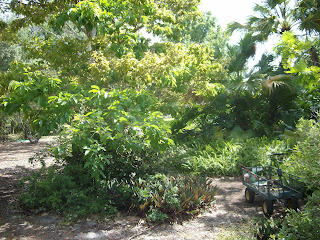 Pic 4. 9:45a.m. Crape Myrtle Back Shot Before
 Pic 5. 11:15 a.m. Crape Mrytle Back Shot After
 Pic 6. 11:30 a.m. The Back Entrance Path with ferns taking over.
 Pic 7. 12p.m. 93F and Aaron pulling out ferns, widening the path.
 Pic 8. 12:50 p.m. The Back Entrance Path after thinning out some ferns.
This Weeks Palm Features!
 These guys are some of the first palms that you see once you enter the back side. Located across from the "Danger Zone"
Palm 1
 Name Plate of Palm 1
 Full Shot

Fronds The underside of the frond showing the white coloring.
 Fibrous Crown
 The roots with the little spines.
Palm2
 Name Plate Palm 2 w/misspelling "Syagrus"
 Full Shot
 Fronds
Palm 3
 A couple of young Sabal minors , Dwarf Palmetto
 Young tree just beginning to trunk.
 The fruit of the Sabal minor still ripening.
 Pic 1. 9:45 a.m. Crape Mrytle Front Shot Before
 Pic 2. 11:15a.m. 5cart dumps later Crape Mrytle Front Shot After
 Pic 3. 10:15 Aaron from A Yard in Ft Pierce trimming some of the bigger stuff back
 Pic 4. 9:45a.m. Crape Myrtle Back Shot Before
 Pic 5. 11:15 a.m. Crape Mrytle Back Shot After
 Pic 6. 11:30 a.m. The Back Entrance Path with ferns taking over.
 Pic 7. 12p.m. 93F and Aaron pulling out ferns, widening the path.
 Pic 8. 12:50 p.m. The Back Entrance Path after thinning out some ferns.
This Weeks Palm Features!
 These guys are some of the first palms that you see once you enter the back side. Located across from the "Danger Zone"
Palm 1
 Name Plate of Palm 1
 Full Shot
Fronds
 The underside of the frond showing the white coloring.
 Fibrous Crown
 The roots with the little spines.
Palm2
 Name Plate Palm 2 w/misspelling "Syagrus"
 Full Shot
 Fronds
Palm 3
 A couple of young Sabal minors , Dwarf Palmetto
 Young tree just beginning to trunk.
 The fruit of the Sabal minor still ripening.


 Posts
Posts